



Ceylon postage stamp year 1861-64 QV 1d blue MH
Ceylon 1861–64 Queen Victoria 1d Blue stamp was engraved and printed by Perkins, Bacon & Co. using a Large Star watermark paper.
Because the initial crisp perforating pins rapidly deteriorated from wear, the 1d value is heavily cataloged by the precision of its perforation holes.
Catalog Identification & Varieties
The 1d blue is categorized into three main perforation states. Determining which one you have dramatically impacts its catalog profile:
1. Clean-Cut or Intermediate Perforations (1861)
- Perforation: 14 to 15½ (Holes are perfectly round and cleanly punched)
- Stanley Gibbons: SG 19 (Light Blue) or SG 19a (Blue)
- Scott Catalog: Scott 17
2. Rough Perforations (1861–1864)
- Perforation: 14 to 15½ (Ragged, torn holes where the paper discs didn’t detach cleanly)
- Stanley Gibbons: SG 27 (Blue) or SG 28 (Dull Blue)
- Scott Catalog: Scott 28
- Note: This variety is much more common than the clean-cut version. Keep an eye out for a constant plate variety on SG 28 showing a prominent design doubling (re-entry) in the word “CEYLON”.
3. Star Watermark / Short-Lived Perforation 12½ (1862)
- Perforation: 12½ (A distinct gauge change printed briefly on Star watermarked paper)
- Stanley Gibbons: SG 35 (Dull Blue)
- Scott Catalog: Scott 28a
Technical Specifications
| Attribute | Details |
| Country | Ceylon (British Colony) |
| Year of Issue | 1861–1864 |
| Denomination | 1 Penny (1d) |
| Printer | Perkins, Bacon & Co. |
| Printing Method | Line-engraved (Intaglio) |
| Watermark | Large Star |
Watch Out for Later Releases:
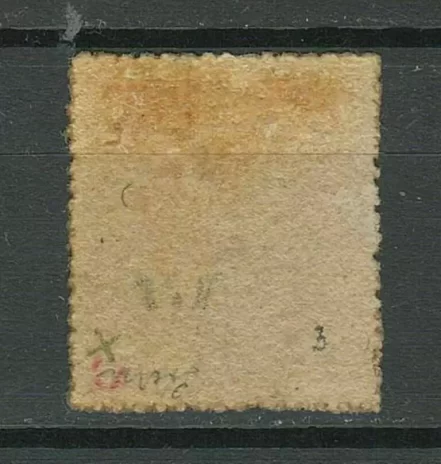
In late 1863, De La Rue took over printing operations. They released a 1d stamp that looks nearly identical from the front, but it is printed on completely different paper. If the back reveals a Crown CC watermark (SG 49) or an unwatermarked soft paper instead of the Star, it belongs to the later 1863–1865 De La Rue printings.



Reviews
There are no reviews yet.