
Showing all 9 resultsSorted by latest



Showing all 9 resultsSorted by latest
The postal history of the Mediterranean island nation of Malta is a collector’s dream. Because of its highly strategic location, Malta served as a vital naval fortress for the British Empire before gaining independence.
Malta’s stamps document a beautiful, linear journey from a standard British Crown Colony to a self-governing island, and finally to an independent European Republic.
1860 Halfpenny Yellow (Malta’s first solitary issue). Source: Wikipedia / Halfpenny Yellow – Wikipedia
The Four Main Eras of Maltese Philately
1. The Pre-Stamp & British Colony Era (1860–1921)
Before 1860, British stamps were used in Malta, identifiable today only by their unique Mediterranean postmarks (like the “M” or “GBC” killer cancels).
The Halfpenny Yellow (1860): Malta’s very first dedicated stamp was issued on December 1, 1860. It featured the head of Queen Victoria and was printed in a pale yellow-buff shade. For nearly 25 years, this was the only custom stamp Malta had—used exclusively for local mail within the island, while British stamps handled international letters.
The Pictorials (1899): Malta broke away from basic royal portraits in 1899, launching a striking definitive set illustrating the island’s unique architecture and history, including the Grand Harbour of Valletta and the iconic Gozo boat (dghajsa).
2. Self-Government & The “Melita” Era (1921–1964)
In 1921, Britain granted Malta a new constitution allowing for internal self-government. This political awakening sparked some of the most famous stamp designs in the Mediterranean.
The Melita Issues (1922): To celebrate their new political status, Malta released the legendary Melita series (pictured above). Designed by local artist Edward Caruana Dingli, it shows the robed allegorical figure of Melita (representing Malta) embracing Britannia, signifying a partnership rather than strict subjugation.
The Overprints: Before the Melita stamps were ready, the post office took older colonial stocks and hand-stamped them with “SELF-GOVERNMENT”—highly prized by error collectors for font shifts and double-strikes.
The George Cross (1943): Following Malta’s heroic, grueling defense against Axis bombing during WWII, King George VI awarded the entire island the George Cross. Malta proudly incorporated this medal into its stamp designs starting in 1943, a feature that remains on Maltese stamps and its national flag to this day.
3. Independence & The Republic (1964–2007)
Malta gained full independence from Britain on September 21, 1964.
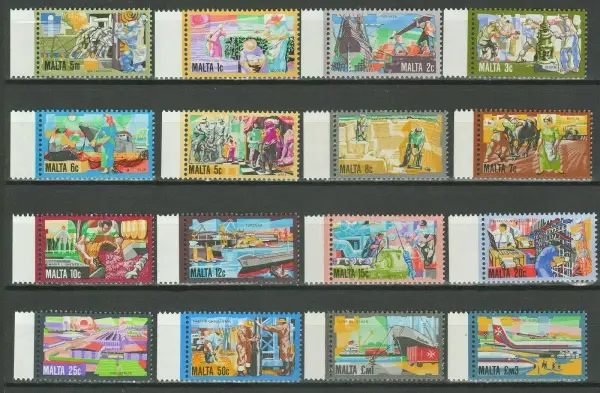
Design Shifts: The British monarch’s silhouette finally disappeared from the corner of the stamps. They were replaced by bold, colorful, modern designs celebrating Maltese folklore, prehistoric megalithic temples (like Ħaġar Qim), and local Catholic festas.
Currency Change: In 1972, Malta phased out the old British currency system, introducing the Maltese Lira (Lm) subdivided into cents and mils.
4. Modern Malta & The Euro Zone (2008–Now)
On January 1, 2008, Malta officially adopted the Euro (€). Modern issues by the national postal operator, MaltaPost, are highly professional and heavily thematic. They lean into Malta’s booming tourism market, featuring magnificent visual sets honoring Mediterranean marine life, the historic fortifications built by the Knights of St. John, and classical Maltese transport buses.