
Showing all 22 resultsSorted by latest










Showing all 22 resultsSorted by latest
The postal history of Switzerland is legendary in the philatelic world. Switzerland was the second country in the world—surpassed only by Great Britain—to introduce adhesive postage stamps.
Because Switzerland is a multilingual federation with four official languages, the country solved the problem of what text to print on its stamps by using its ancient Latin name: Helvetia.
The Three Iconic Eras of Swiss Stamps
1. The Pre-Federal “Cantonal” Classics (1843–1850)
Before the Swiss Confederation centralized the mail system in 1848, individual regions (cantons) issued their own highly primitive, incredibly rare stamps. These are considered the “Holy Grails” of Swiss collecting:
The Zurich 4 and 6 (1843): The very first Swiss stamps, featuring large numbers on a fine background grid.
The Double Geneva (1843): A unique stamp consisting of two halves. Each half could pay a local city rate, or the two halves could be used together to pay an inter-city rate.
The Basel Dove (1845): Widely considered one of the most beautiful stamps ever made. It was the world’s first tri-colored stamp (printed in black, crimson, and blue) and featured a prominent embossed white dove flying with a letter in its beak.
2. The Early Federal Inscriptions (1850–1907)
Once the federal government took over, Swiss stamp design standardized, introducing advanced security measures to thwart counterfeiters.
The “Rayon” and “Ortspost” Issues (1850–1852): Simple, unperforated stamps featuring a post horn behind a Swiss cross shield.
The Strubel Series (1854–1862): Officially known as the Sitting Helvetia, these stamps are nicknamed “Strubel” (unkempt hair) by Swiss collectors because of the slightly messy look of Helvetia’s crown of laurels.
The Silk Thread Security: Like early Württemberg issues, the Sitting Helvetia stamps were printed on paper embedded with a thin, colored silk thread running horizontally through the sheets.
3. The Modern Commemoratives & Charity Sets (1907–Present)
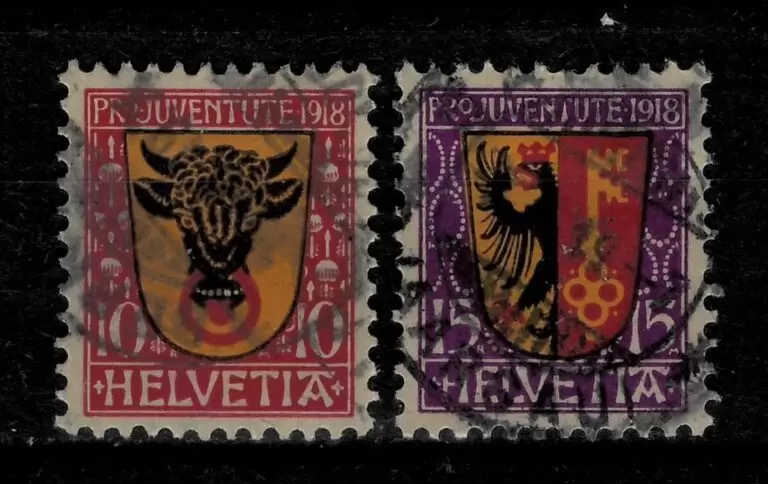
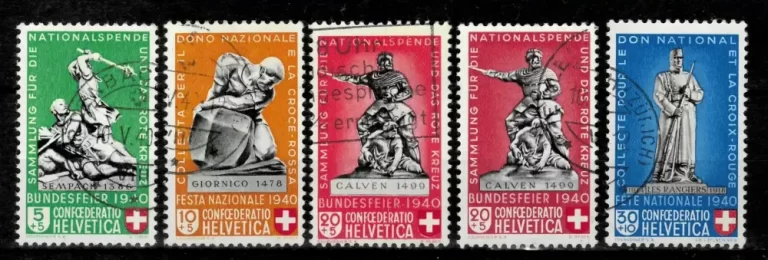
Switzerland pioneered the concept of high-quality semi-postal stamps—stamps sold for more than their face value, with the extra money going directly to charity.
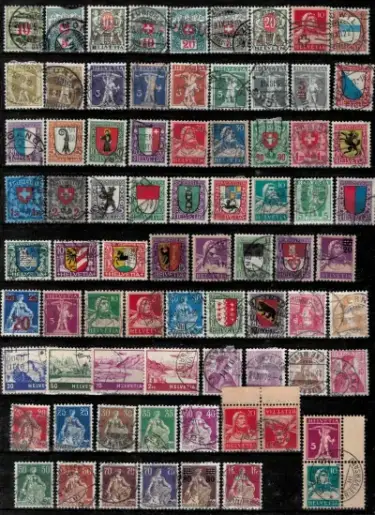
Pro Juventute (For the Youth): Launched annually since 1913, these beautifully designed stamps traditionally feature regional Swiss traditional costumes, native flowers, and cantonal coats of arms (like the 1922 examples pictured above).
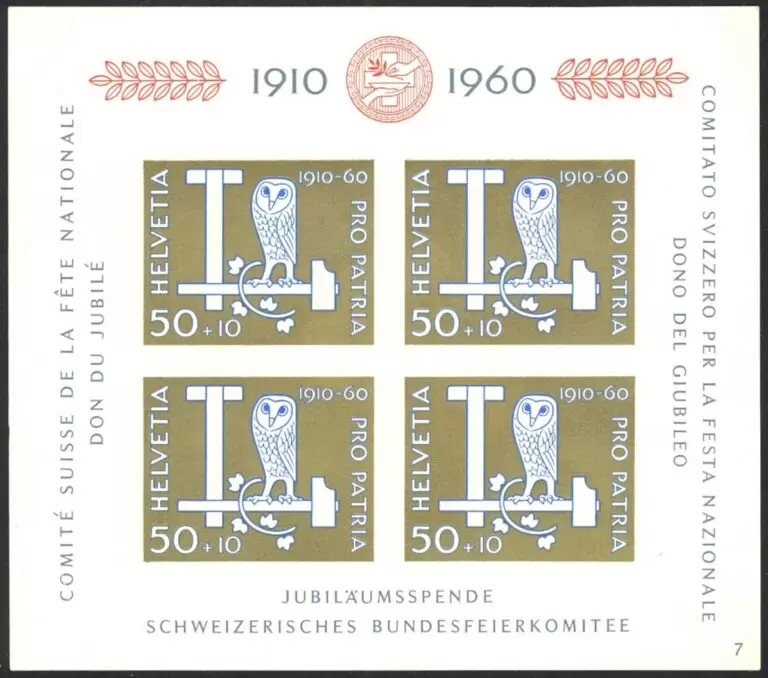
Pro Patria (For the Fatherland): Launched annually since 1936 to fund cultural, historical, and architectural preservation projects across Switzerland.