
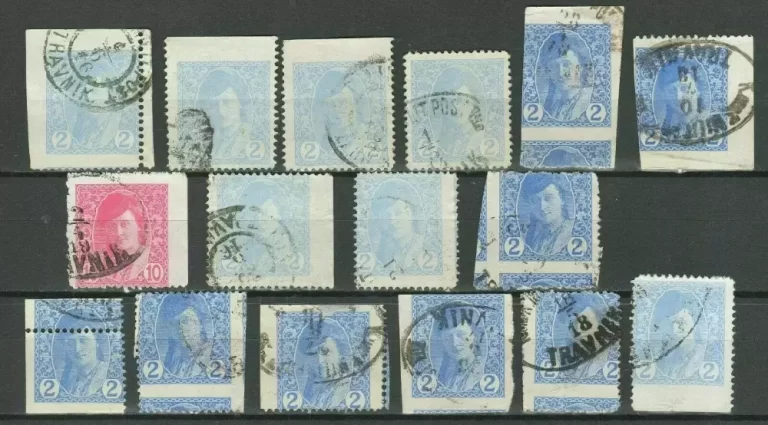


Bosnia year 1913 Newspaper stamps errors
The 1913 Bosnia and Herzegovina Newspaper stamps are a highly specialized area of classical Balkan philately. This four-stamp set features the iconic design of a “Bosnian Girl” in traditional regional costume (Michel #OB85–#OB88 / Scott #P1–#P4) and was originally issued in an imperforate (smooth-edged) format with 2h, 6h, 10h, and 20h denominations.
Because these stamps were used continuously through a collapsing empire and into a new kingdom (SHS/Yugoslavia), they are famous for an immense volume of production errors, overprint varieties, and extensive historical forgeries.
1. The 1918 Surcharged Overprint Errors
The most dramatic “errors” associated with the 1913 Bosnian Girl design actually happened in late 1918 during the post-WWI transition. Short on stamps, the new administration took leftover sheets of the 1913 imperforate newspaper stamps and overprinted new values onto them.
- The Issues:
3h on 2h (Blue)and5h on 6h (Orange). - Inverted Overprints: Sheets were manually fed upside down, resulting in the new surcharge value being printed completely inverted.
- Double Overprints & Shifts: Rushed letterpress operations caused numerous double strikes (two layers of text) or heavily shifted surcharges where the new price printed completely off-center or across two stamps.
2. The Perforation Varieties (The “Accidental” Regular Issues)
The 1913 Bosnian Girl stamps were strictly designed to be imperforate. However, by 1918, early Yugoslav postal authorities in Ljubljana and Sarajevo needed regular perforated postage.
- They took leftover 1913 plates and sheets and ran them through whatever perforation machines were available.
- This created highly irregular mixed-perforation errors (e.g., lines measuring $11\frac{1}{2}$, $12\frac{1}{2}$, or even different perforations on the top/bottom versus the left/right sides). In philately, an intact 1913 sheet that was unofficially or textually mis-perforated during the chaotic 1918 window commands a heavy premium.
3. The Great Philatelic Trap: Genuine vs. Forgery
If you are looking at a lot of 1913 Bosnian Girl stamps and they look blurry or inconsistent, there is a 5-to-1 chance they are old counterfeits. Because the originals were simple, unperforated designs, they were heavily forged in Central Europe during the 1920s to trick collectors.
Knowing how to spot the difference will instantly protect your collection:
| Feature | Genuine 1913 Stamp | 1920s Forgery / Counterfeit |
| Printing Method | Lithographed (Smooth, clean ink distribution) | Coarse Typo/Litho (Blurry, uneven, or smudged details) |
| The Girl’s Face | Crisp, finely detailed eyes and facial features. | Soft, distorted face; eyes often look like plain dark dots. |
| Background Lines | The fine horizontal lines behind the portrait are perfectly parallel. | The background lines are uneven, wavy, or blend together. |

Reviews
There are no reviews yet.