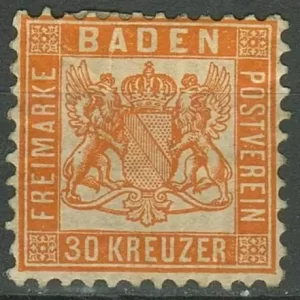
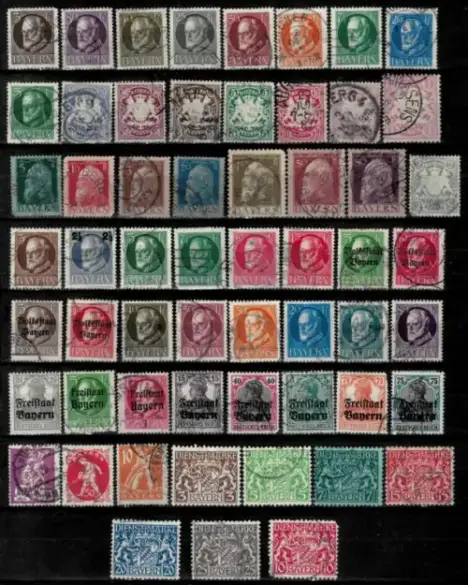
Bavaria Bayern postage stamps year 1870-1916 Used collection
Bavaria (Bayern) holds a unique place in postal history because it was the first German state to issue postage stamps (1849) and maintained its own postal sovereignty even after the German Empire was unified in 1871.
The period between 1870 and 1916 covers the transition from the old “Kreuzer” currency to the “Pfennig/Mark” system and the move from simple Coat of Arms designs to royal portraits.
1. The Coat of Arms Era (1870–1911)
For several decades, the primary design for Bavarian stamps was the embossed Bavarian Coat of Arms.
- 1870–1875 (Kreuzer Issues): These stamps were issued in denominations of 1, 3, 7, 10, 12, and 18 Kreuzer. They are distinguished by their watermarks (intersecting wavy lines/zigzags) and silk threads in the paper.
- 1876 (Currency Change): When the German Empire unified its currency, Bavaria switched to Pfennig and Mark. The 1876 series reused the Coat of Arms design but with the new values.
- 1881–1911: Further definitive issues of the Coat of Arms were released. Philatelists distinguish these primarily by watermark variations (vertical vs. horizontal wavy lines) and paper color (toned vs. white).
2. The Commemorative & Portrait Era (1911–1916)
Starting in 1911, Bavaria began issuing more ornate stamps, often celebrating the royal family.
- 1911 Prince Regent Luitpold Jubilee: This was a massive issue to celebrate the 90th birthday of the Prince Regent. It features his portrait and comes in many “Types” (I, II, and III) based on small differences in the inscription and serifs of the numbers.
- 1914 King Ludwig III Definitives: These are the most common Bavarian portrait stamps. They feature King Ludwig III and were used throughout World War I.
- 1916 “Wartime” Printings: Because of the war, the 1914 designs were reprinted in 1916 with coarser paper, rougher printing quality, and thicker gum.
3. Key Identification Features
If you are looking at stamps from this era, pay close attention to these three factors:
| Feature | Details |
| Watermarks | Wavy lines are the most common. The direction (vertical or horizontal) and spacing often determine if a stamp is a common variety or a rare one. |
| Currency | Stamps marked in Kr. (Kreuzer) are pre-1876; those in Pf. or Mark are post-1876. |
| Perforation | Most stamps of this era are perforated $11.5$ or $14.5$, though some rare imperforate varieties exist for the high Mark values. |
Notable “Back of the Book” Issues
- Official Stamps (Dienstmarken): Often featuring the Coat of Arms with an “E” (for Eisenbahn / Railway) or other overprints.
- Air Mail (1912): Bavaria issued some of the world’s first airmail stamps in 1912 for the Munich-Upper Bavaria flights.
- Telegraph Stamps: Often used for postal purposes, these look similar to the Coat of Arms issues but are labeled “Telegraph.”