
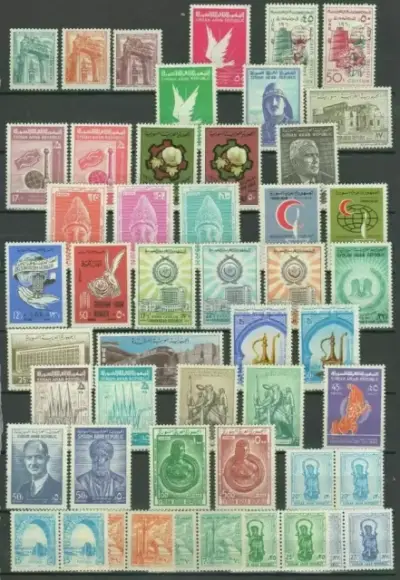
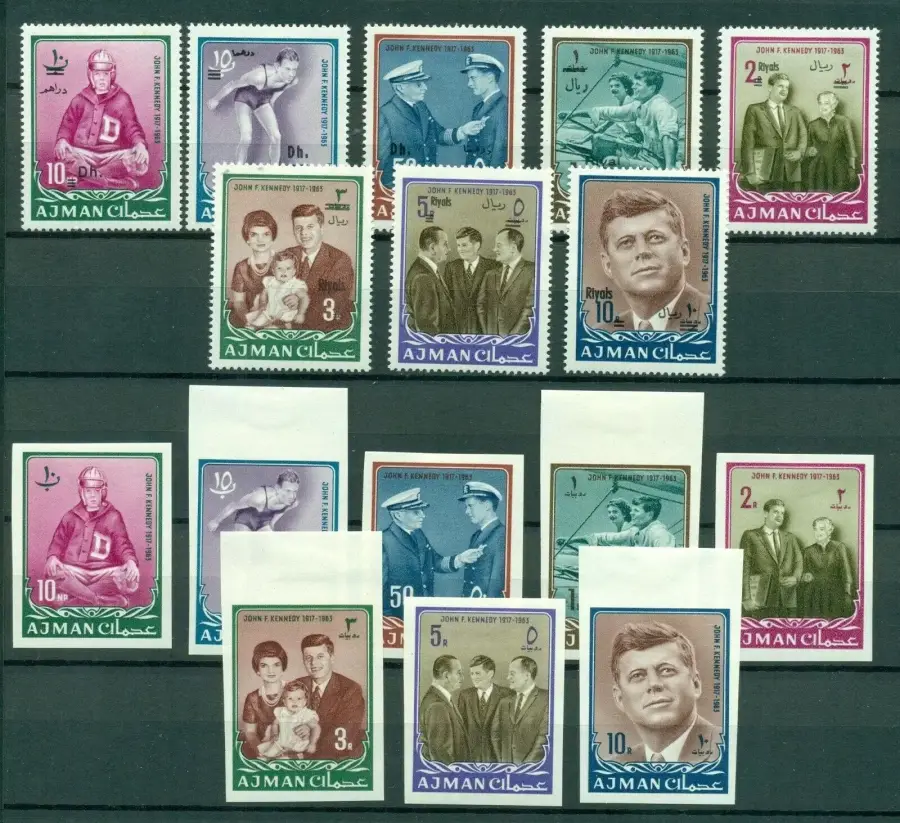
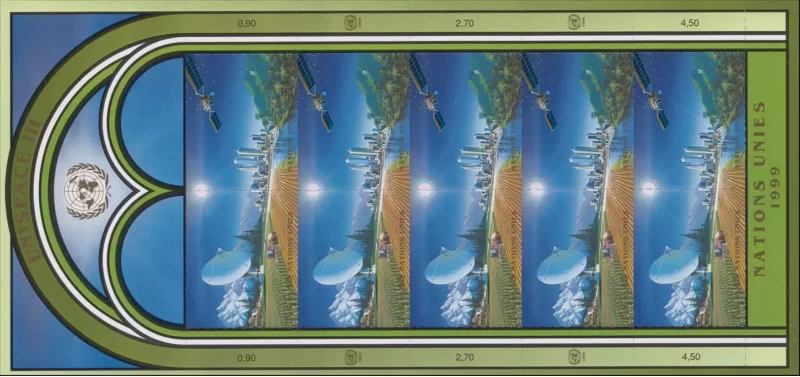
Syria 1950/1970 postage stamps Mint never hinged lot
Syrian philately from 1950 to 1970 is particularly popular among collectors because it covers the transition from a young independent republic to the short-lived union with Egypt, followed by the rise of the modern Syrian Arab Republic.
1. The Early Republic (1950–1957)
Stamps from this era are often elegant, engraved designs focusing on national landmarks and archaeological pride.
- Key Issues:
- 1950 Definitive Set: Features the Coat of Arms, a view of a street in Damascus, and the Central Post Office.
- 1952 Buildings Set: Depicts architectural gems like the Umayyad Mosque and the Azm Palace.
- Airmail Gems: High-value airmails from 1952 are famous for their depictions of the Citadel of Aleppo (25p blue) and the Palmyra Triumphal Arch (15p violet).
- Special Marks: Look for “Special Delivery” stamps from 1950 depicting a messenger on a motorcycle.
2. The United Arab Republic (UAR) Period (1958–1961)
This is a unique “mini-era” where Syria and Egypt merged. These stamps are essential for any Middle Eastern collection.
- How to Identify: Stamps are inscribed with “U.A.R.” or “Republique Arabe Unie.”
- The Currency Trick: Egyptian UAR stamps are in Millièmes (M), while Syrian UAR stamps are in Piastres (P).
- Notable Issue: The 1958 Glider Festival and the Damascus International Fair series are classic examples of UAR-era Syrian stamps.
3. The Syrian Arab Republic (1962–1970)
After withdrawing from the UAR in late 1961, Syria began a prolific period of thematic and commemorative releases.
- Key Themes:
- Archaeology: The 1964 Mosaic of Philippopolis and 1969 Ancient Buildings sets are highly detailed.
- Folk Art (1970): A vibrant series designed by the famous artist Abou Subhi al-Tinawi features traditional folk tales like Jassas and al-Zir Salim.
- Industry & Progress: Many sets celebrate “Youth Week,” the “Cotton Fair” in Aleppo, and the “March Revolution.”
- Special Postmarks: The Damascus International Fair (held annually in August/September) always featured unique special cancellations that are highly collectible on covers.
4. Technical Details & Value
- Watermarks: Early issues often have no watermark. By the mid-60s, a “Small Arms” (eagle) watermark became standard.
- Paper: In the late 60s, Syria moved to a distinctive “Granite Paper” (look for tiny colored fibers in the paper).


Reviews
There are no reviews yet.