
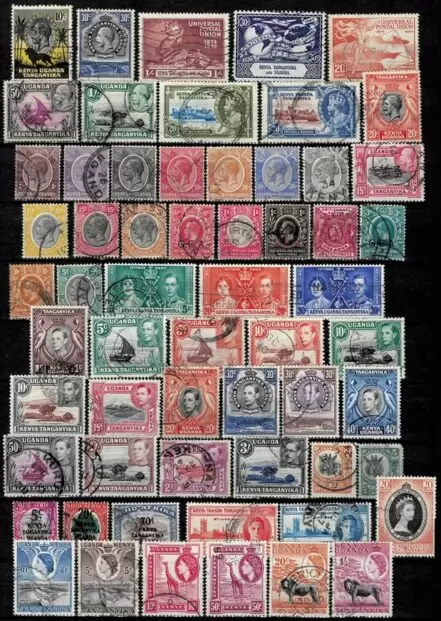
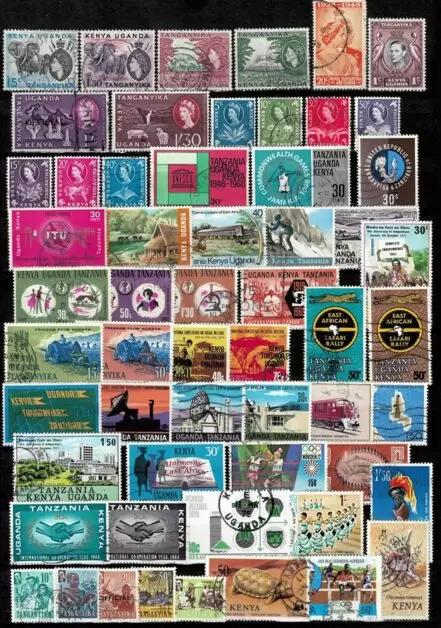

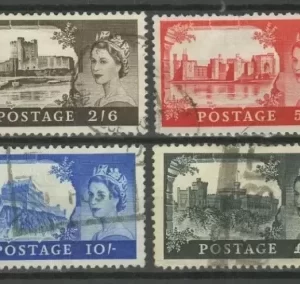
Kenya Uganda and Tanganyika year 1900/1960 stamps Used collection
The postage stamps for Kenya, Uganda, and Tanganyika between 1900 and 1960 represent a complex and changing postal history under British colonial administration.
Here is a breakdown of the key stamp issuing entities during that period:
1. Separate Territories & Early Joint Issues (1900–1935)
- British East Africa (Kenya): Early stamps in the 1890s were inscribed “BRITISH EAST AFRICA.” By 1904, the postal service merged with Uganda.
- East Africa and Uganda Protectorates (1904–1922): These were the first stamps to officially cover both territories, often featuring the head of King Edward VII or King George V.
- Kenya and Uganda (1922–1935): Stamps issued under the “Kenya and Uganda” postal administration.
- Tanganyika Territory: As a former German colony, it was administered by Britain after World War I. Stamps were initially German East Africa stamps overprinted (e.g., “G.E.A.” or “NACHUFA”), followed by stamps inscribed “TANGANYIKA.”
2. Kenya, Uganda, and Tanganyika (KUT) Issues (1935–1960)
The famous “Kenya, Uganda, Tanganyika” (KUT) inscriptions began in 1935 when the postal services of the three territories were formally amalgamated into the East African Posts and Telecommunications Administration.
- King George V (1935): The first KUT issues were common designs for the Silver Jubilee of King George V, followed by a definitive series featuring the King’s profile and local scenes.
- Notable features: Early definitives included a design featuring a silhouette of a lion, which was a dramatic departure for the period.
- King George VI (1938–1952): The definitive series was reissued in 1938 with a portrait of King George VI. The period also saw commemorative sets (like the 1946 Peace Issue) and wartime surcharges.
- Queen Elizabeth II (1954–1960): A new definitive series with fresh designs was issued for Queen Elizabeth II in 1954. Commemorative sets continued, such as those for the discovery of the Great Lakes (Burton and Speke) in 1958.
- A new definitive series with simpler, more symbolic designs was released in 1960.
These KUT issues were valid across all three territories. The joint issues continued even after the countries began achieving independence (Tanganyika in 1961, Uganda in 1962, and Kenya in 1963).
What to look for in a collection:
- Inscriptions: Look for “BRITISH EAST AFRICA,” “EAST AFRICA & UGANDA PROTECTORATES,” “KENYA & UGANDA,” “TANGANYIKA,” and the final “KENYA, UGANDA, TANGANYIKA.”
- Condition: Like all stamps, value depends on condition. Mint Never Hinged (MNH) stamps (unused with original gum, no hinge marks) are typically the most valuable.
- Key Issues:
- The 1935 Definitive series with the unique Lion high-value stamps.
- Early overprinted stamps from the pre-1922 period, especially those on German or Indian stamps.
- The various definitive sets that depict colonial scenes, wildlife, and portraits of the reigning monarchs (Edward VII, George V, George VI, and Elizabeth II).
Reviews
There are no reviews yet.