


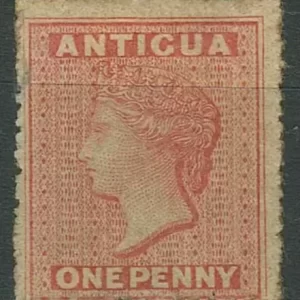
Great Britain postage stamp year 1841 1d Deep red brown Used
🇬🇧 Great Britain 1 d Red-Brown (1855 era)
📜 What Stamp This Is
- Name (common): Penny Red (1 d) – standard British definitive for one penny postage.
- Issued: Perforated versions from 1854 onwards, with changes around 1855.
- Design: Queen Victoria profile (same basic design as earlier Penny Reds).
- Perforation: Early experiments used gauge 16; it was changed to gauge 14 in 1855.
📌 Perforations: 16 & 14
🟡 Perforation 16 (Gauge 16)
- Introduced: Officially in 1854 on many Penny Reds.
- Characteristics: Many stamps printed with perf 16 before 1855.
- Why changed: The hole size was found to be too fine so sheets would tear easily.
- Collectors: This type persists on stamps printed into early 1855.
🟢 Perforation 14 (Gauge 14)
- Introduced: January 1855 as the standard choice to strengthen sheet integrity.
- How to tell: Larger perforation holes per 2 cm (14 around 2 cm vs. 16 for the earlier type).
- Co-existence: Both perf 14 and perf 16 stamps were produced around 1855–1857 as the Post Office transitioned.
🧾 Key Varieties Around 1855
In the mid-1850s, Penny Reds with the following features existed:
| Feature | Perf 16 | Perf 14 |
|---|---|---|
| Watermark | Small crown or large crown on some printings | Small crown or large crown |
| Alphabet / Die | Alphabet II, early dies | Alphabet II, re-engraved Die II |
| Date Range | Mainly 1854–1855 | Introduced Jan 1855 and continued |
| Collector Interest | Early perf 16 with certain watermarks can be scarcer | Perf 14 also collectible, varies by plate & watermark |
🧠 Historical Notes
- The Penny Red was Britain’s main 1 d definitive stamp from 1841 to 1879.
- Perforation was a new technology in the 1850s; Henry Archer developed the first usable machines.
- Perf 16 was the first widely-used perforation, but it was soon changed to the sturdier perf 14.
- After 1864 the stamps were changed to show letters in all four corners and a plate number engraved in the design — but mid-1850s issues still lack the engraved plate number within the stamp design (plate numbers exist only in the margins).
Reviews
There are no reviews yet.