
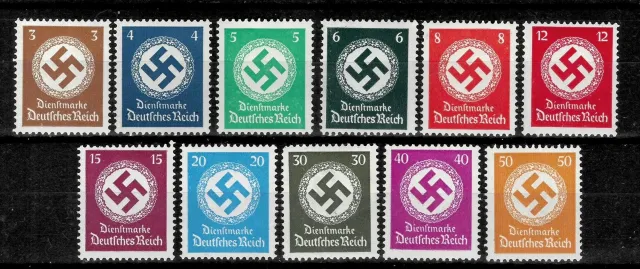


Germany Weimar Republic year 1934-38 Dienstmarke stamps MNH
That period is highly significant because it marks the complete transition from the Weimar Republic to Nazi Germany (The Third Reich), and the stamps reflect this political and ideological shift.
While the design of the Official Stamps remained largely the same for a few years, the country’s official name was still Deutsches Reich (German Reich), and the governing body changed.
Here is a breakdown of the Dienstmarke stamps from 1934 to 1938:
1. Continuation of the “Dienstmarke” Series (1934 Issues)
The earliest stamps of this period were a continuation of the definitive series that had been in use since the stable currency was introduced in late 1923.
- Design: These stamps generally feature the Reichsadler (Imperial Eagle) in a circular design, often with the value in the center, and the word “Dienstmarke” at the top or bottom.
- Watermark: A crucial change began in this period. While earlier issues used the lozenge watermark, the new stamps introduced after 1933 began incorporating the swastika watermark (Wz. 3 – Swastikas in lozenges) into the paper, reflecting the new regime.
- Michel Nos.: These are typically cataloged as Michel Dienstmarken (Official Stamps) numbers 134-143 (issued around 1934). The color and minor design variations often distinguish these from their Weimar predecessors.
2. The Final Official Stamp Series (1938 Issues)
In 1938, a completely new series of official stamps was issued that fully embraced the symbolism of the Nazi regime.
- Design: The 1938 official stamps feature the new, distinctive Nazi Government Emblem: the Reichsadler (Imperial Eagle) looking to the right, perched atop an oak wreath holding a Swastika in its talons.
- Wording: They retained the text “Deutsches Reich” and the denomination, often with the word “Dienstmarke” incorporated into the border design.
- Significance: This 1938 series (Michel Nos. 144-154, with denominations from 1 Pfennig to 40 Pfennig) was the final series of Dienstmarke for the Third Reich. This design would remain in use until the collapse of the regime in 1945. These stamps were intended for use by government offices, including those of the National Socialist Party itself, to send official mail.
The stamps of 1934-1938 are historically significant because they document the immediate and complete shift of Germany’s official postal identity from a parliamentary republic to a totalitarian state, with the swastika becoming a prominent feature, first as a watermark and then as a central design element.

Reviews
There are no reviews yet.