
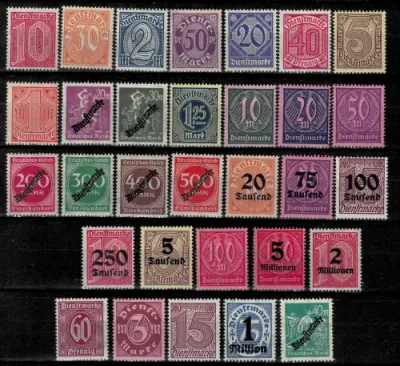
Germany Weimar Republic year 1920/1923 – Dienstmarke stamps MNH
The Dienstmarke (Official Stamps) from the Weimar Republic between 1920 and 1923 are particularly interesting because this period covers the beginning of the Republic and the peak of the disastrous hyperinflation.
Here is an overview of the key phases and types of Dienstmarke stamps from that time:
1. Introduction of Official Stamps (1920)
Before 1920, some German federal agencies were exempt from postage. This changed, and the use of official stamps became mandatory for German state agencies on April 1, 1920, and for federal agencies on July 1, 1920.
- 1920 Numerals: The earliest general official stamps featured denominations in large-format numbers.
- Overprints on State Stamps: Initial issues for certain regions were created by overprinting existing stamps from former German states, such as:
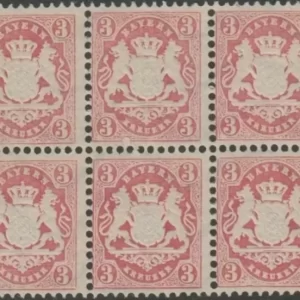
- Bavaria Overprints: Existing Bavarian stamps were overprinted with “Deutsches Reich” for the new unified postal system.
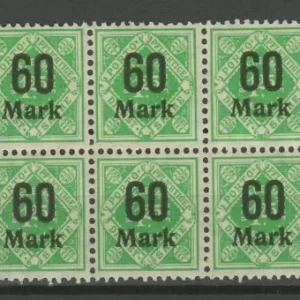
- Württemberg Overprints: Stamps from Württemberg were similarly overprinted.
- 1921/1922 Issues: This period saw the continuation of numeral designs and the start of other minor numeral issues.
2. The Hyperinflation Period (1922-1923)
The most dramatic and collectible stamps in this series are those from 1923, known as the “Infla-Dienstmarken” (Inflation Official Stamps). The hyperinflation of the German Mark led to astronomical increases in postal rates, which the government addressed by constantly re-issuing and overprinting stamps.
- New Denominations (Inflation Issues): As the value of the Mark collapsed, stamps with increasingly large face values had to be issued.
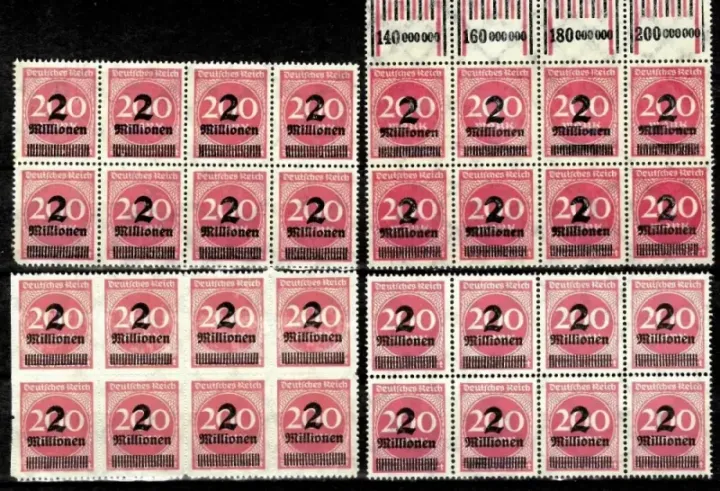
- “Dienstmarke” Overprints: A common and defining feature of 1923 is the practice of taking a regular issue stamp (which quickly became obsolete) and applying a new, much higher value overprint, often denoted with “T” for Tausend (Thousand) or “M” for Million (Million).
- For example, a stamp originally valued at 15 Mark might be overprinted to 100 Tausend Mark (100,000 Mark) or even millions of Marks, sometimes in multiple overprint steps. These are often identified in catalogs using Michel (MiNr.) Official Stamp numbers.
- High Values: The denominations grew rapidly, moving from thousands to millions, and eventually billions and trillions of Marks by the end of 1923.
3. Transition to New Currency (Late 1923)
The hyperinflation was halted by the introduction of the new currency, the Rentenmark, in November/December 1923.
- Revalued Overprints: Stamps from this very brief period had overprints to reflect the new, stable currency, often in Rentenpfennig.
The 1920-1923 period, especially 1923, is one of the most dynamic and chaotic in German philately, perfectly illustrating the economic crisis of the Weimar Republic.
Reviews
There are no reviews yet.