
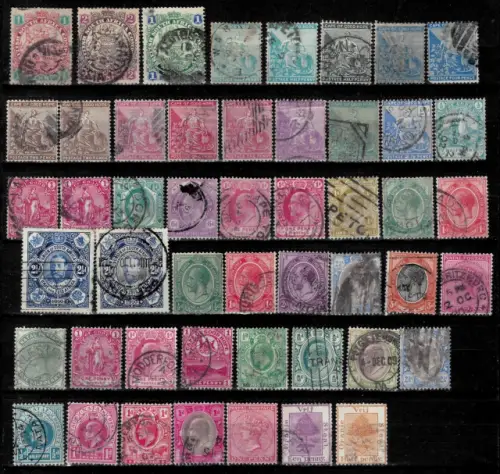
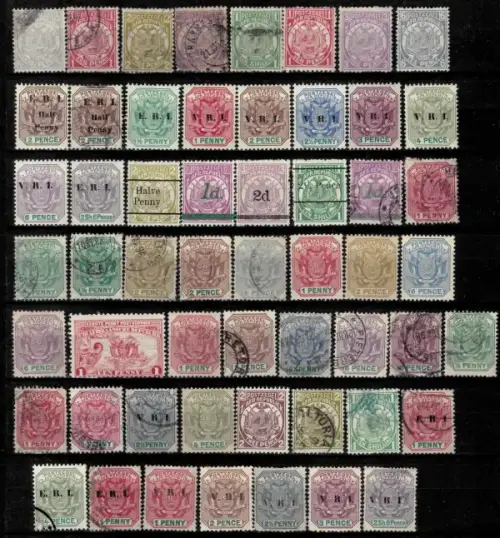
South Africa postage stamps – Cape of Good Hope year 1864 – 1920 used stamps
The Cape of Good Hope was a British Crown Colony until 1910, when it was incorporated into the Union of South Africa. The stamps issued between 1864 and 1920 represent the transition from its iconic early issues through to the consolidation of the Union.
Here is a breakdown of the key stamp series from the Cape of Good Hope during this era:
1. The “Hope Seated” Rectangular Issues (1864–1898)
In 1864, the Cape Colony officially discontinued the famous Triangular stamps (which were first issued in 1853) and switched to the more common rectangular format featuring the allegorical figure of Hope seated with a ram and vines.
- Design: “Hope Seated,” sometimes called the “Hope and Anchor” design.
- Significance: This became the standard definitive design for the Cape Colony for over three decades.
- Key Differences: This series has many specialized collecting points related to watermarks, perforations, and the presence or absence of an outer frame line:
- First Issue (1864–1877): Featured a frame line around the entire design and the “Crown and CC” watermark.
- Later Issues (1871–1898): The outer frame line was omitted (or appeared only on certain values) and featured different watermarks like “Crown and CA” or the single-lined Anchor watermark.
- Rarity: Most stamps from this long-running series are common, especially used copies, but collecting the different shades, watermarks, and perforation varieties can be highly specialized.
2. Provisional and Surcharged Issues (Late 1800s)
Like many colonies, the Cape often ran out of specific values and had to create temporary stamps by surcharging or overprinting existing stock.
- 1874: The 6d Deep Lilac stamp was overprinted “ONE PENNY” (SG 32-33).
- 1882: The 3d Deep Claret stamp was overprinted “ONE HALF PENNY” (SG 47).
- 1893: The 2d Bister stamp was overprinted “ONE PENNY” (SG 57).
These provisionals can be highly collectable, especially those with errors or varieties (like “No Stop” after “Penny”).
3. The “Hope Standing” and Landscape Issues (1893–1900)
Towards the end of the 19th century, new designs were introduced:
- 1893: “Hope Standing” A new design featuring the figure of Hope standing with Table Bay in the background was introduced for the 1d value, and later for the $1/2d$ and $3d$ values (MiNr. 59-61).
- 1900: Table Mountain and Arms The 1d value was issued showing Table Mountain and the Colony’s Coat of Arms (MiNr. 62), marking the first stamp not to feature the allegory of Hope.
4. King Edward VII Issues (1902–1904)
Following the death of Queen Victoria and the establishment of British control after the Boer War, the final definitive set for the Cape Colony featured the portrait of the new monarch:
- Design: Profile portrait of King Edward VII.
- Significance: This was the last full definitive set issued specifically for the Cape of Good Hope, preceding the formation of the Union.
5. Union of South Africa (Post-1910)
The Union of South Africa was formed in 1910, unifying the four British colonies (Cape, Natal, Transvaal, and Orange River Colony).
- 1910–1937: Post-Union, stamps issued by the Cape Colony (except the famous triangulars) remained valid for postage throughout the new Union of South Africa until they were demonetized in 1937.
Reviews
There are no reviews yet.