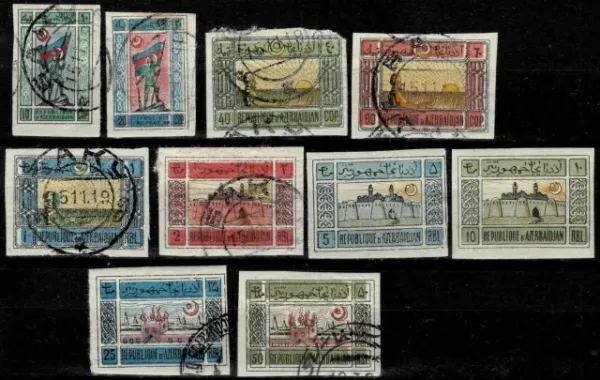

Azerbaijan postage stamps year 1919-20 National Symbols Used set
The first definitive postage stamps issued by the Azerbaijan Democratic Republic (ADR) in 1919, often referred to as the “National Symbols” series, depicted several important national and cultural motifs.
The designs featured four main images across ten different denominations (10 Kopecks to 50 Roubles).
🇦🇿 National Symbols Featured
The four distinct designs symbolizing the new republic’s identity and heritage were:
- Soldier with the National Flag (Denominations: 10 Kopecks, 20 Kopecks)
- This stamp prominently features an Azerbaijani soldier ($asgar$) holding a gun and the Azerbaijani tricolor flag (blue, red, and green stripes with a white crescent and eight-pointed star). This clearly represents the nation’s sovereignty, military, and national identity.
- Peasant/Farmer with Sickle at Sunrise (Denominations: 40 Kopecks, 60 Kopecks, 1 Rouble)
- This design, often captioned as “Land and Freedom,” shows an Azerbaijani peasant harvesting in the field under a rising sun. This symbolizes agriculture, labor, prosperity, and the vital connection to the land.
- Old City of Baku with Fortress Gate and Shirvanshah Palace (Denominations: 2 Roubles, 5 Roubles, 10 Roubles)
- This image presents a panorama of medieval Baku, showcasing the fortress walls and the silhouette of the Palace of the Shirvanshahs. This represents the nation’s capital, history, and architectural heritage.
- Ateshgah (Fire Temple) at Surakhani (Denominations: 25 Roubles, 50 Roubles)
- The stamp features the famous Ateshgah (Temple of Eternal Fires), a fire-worshippers’ temple located in Surakhani. This motif emphasizes Azerbaijan’s nickname, “The Land of Fire,” which stems from its natural gas reserves and historical Zoroastrian ties. This signifies its natural resources and ancient cultural roots.
Context
These stamps were the first independent postal issues of the Azerbaijan Democratic Republic (1918–1920) and were put into circulation starting in October 1919. They were intended to solidify the visual identity of the newly independent nation. The stamps included inscriptions in both Turkic (Azerbaijani) and French (“Republique d’Azerbaidjan”), with the latter being the official language of the Universal Postal Union.