
North Borneo Labuan stamp year 1900 16c Green
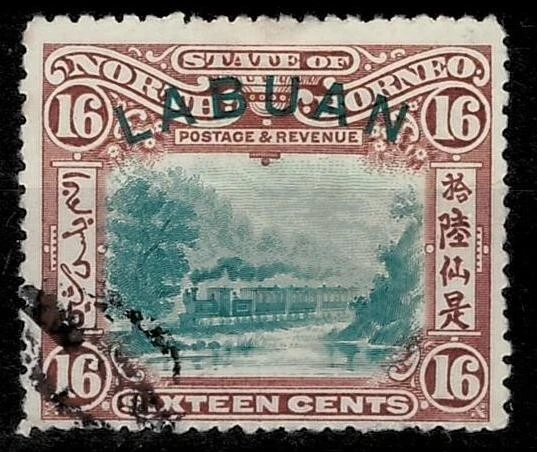
In 1900, the island of Labuan was under the administration of the British North Borneo Company. Because it was cheaper to use existing designs, Labuan used stamps from North Borneo and overprinted them with the word “LABUAN“.
The 16c Green stamp from this year is a classic example of colonial “thematic” philately and is highly prized for its detailed engraving.
1. Identification & Design
- The Image: It features a Steam Train (the North Borneo Railway) crossing a bridge. This is one of the earliest “Railway” topical stamps in the world.
- Colors: The stamp is typically described as Green and Chestnut (or Brown). The frame is green, and the central vignette of the train is brown/chestnut.
- Overprint: It bears a horizontal black overprint that simply reads “LABUAN”.
- Catalog Numbers:
- Stanley Gibbons: SG 116
- Scott: Scott 97 (often grouped with the 1897-1901 pictorials)
2. Technical Details
| Feature | Details |
| Printer | Waterlow & Sons (London) |
| Printing Method | Engraved (Recess) |
| Perforation | Commonly 14 to 15 (varieties exist) |
| Watermark | None |
3. Market Value
Because Labuan stamps of this era were frequently sold to collectors (often cancelled-to-order or “CTO”), their value depends heavily on the type of postmark.
- Mint Never Hinged (MNH): Roughly $60 – $80.
- Mint Hinged: Around $30 – $40.
- Used (Circular Date Stamp): A genuinely postmarked copy with a clear “Labuan” date stamp is actually quite desirable and can fetch $80 – $140.
- CTO (Cancelled to Order): Copies with a neat “bar” or corner cancellation (often done for collectors) are much cheaper, usually $10 – $20.
4. Historical Context
The North Borneo Railway, depicted on the stamp, was a vital part of the region’s development for the tobacco and rubber industries. Just one year after this stamp was issued, in 1901, these same stamps were often overprinted again with new values due to postal rate changes. By 1906, Labuan was incorporated into the Straits Settlements, and these unique pictorials were eventually replaced by the standard “King Edward VII” designs.

Reviews
There are no reviews yet.